Every day, millions of sports bets are placed in the United States—on phones, at work, often while games are still unfolding. With the click of a button, gamblers can wager not only on who wins, but on nearly every moment in between.
For most of American history, this kind of gambling was illegal in much of the country, driven by fears it would taint our sports. That changed in 2018, when the Supreme Court struck down the federal ban on sports betting. Almost immediately, addiction, debt, and harassment surged—as did gambling and game-rigging scandals worth millions.
Why has this happened? And what does it mean for American sports?
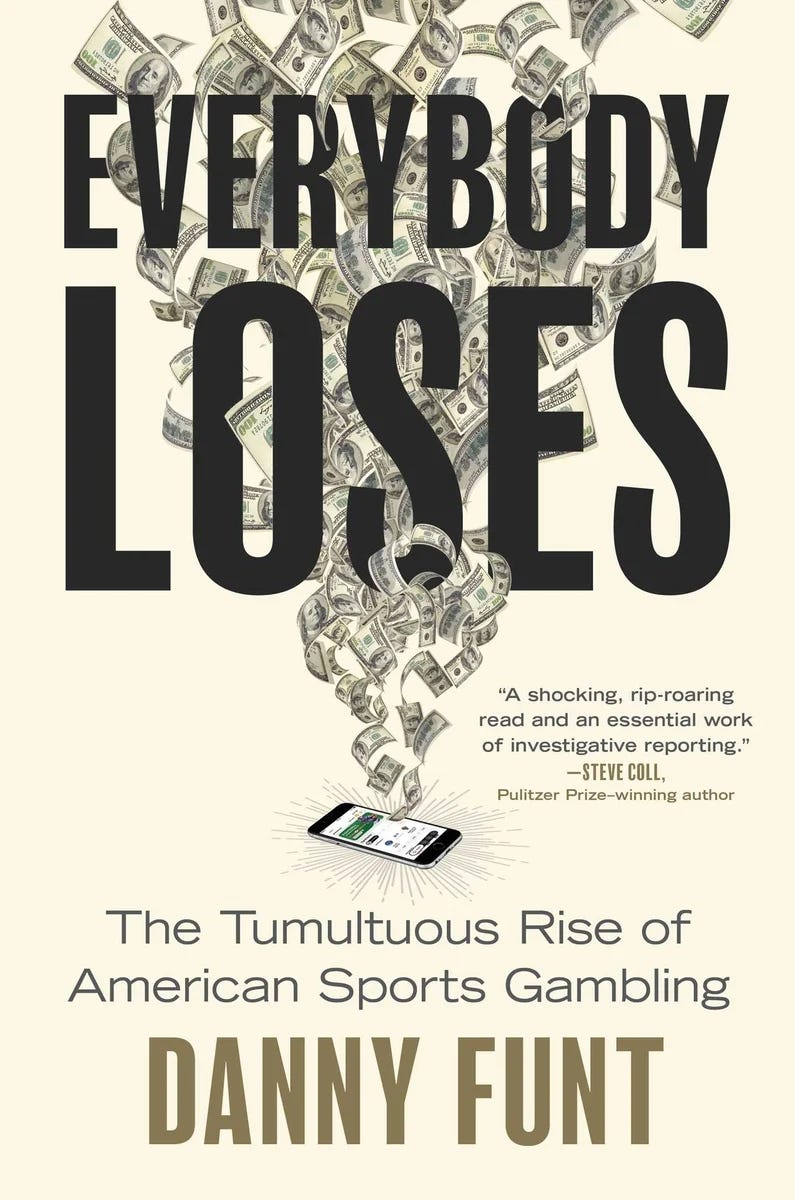
That’s the subject of “Everybody Loses,” a new book from journalist Danny Funt. Hitting shelves January 20, it’s one of the first major investigations into the consequences of that 2018 decision. And in the following essay, adapted from the book, Funt confronts a question at the heart of it all: How has legalized gambling corrupted not only the games, but the fans who watch them? —The Editors

The Purdue University men’s basketball team was a favorite to win the 2024 national championship, but hardly anyone was paying attention to their walk-on guard Carson Barrett. After suffering a serious knee injury earlier that season, Barrett had postponed surgery so he could practice with the team, painful as it was, and cheer his teammates from the bench. In their first game of the March Madness tournament, Purdue cruised to victory, and in the closing minutes, both teams emptied their benches.
The ball swung to a wide-open Barrett in the corner with 35 seconds left and Purdue up 75–50. With a brace on his knee, the lefty caught and fired, swishing a 3-pointer for the game’s final basket—just the second shot he’d made that season.
His teammates were overjoyed. But back in the locker room, as Barrett thumbed through his direct messages on social media, his night took a dark turn:
You sure are a son of a bitch. Hope you enjoy selling cars for the rest of your life.
I hope you fucking die.
Kill yourself for taking that 3 you fucking worthless loser. Slit your fucking throat you fucking fuck that was completely uncalled for.
All this rage, Barrett learned, was coming from gamblers furious that his 3 had allowed Purdue to cover the 27-point “spread.” The spread is a numerical handicap used by bookmakers to make even the most lopsided matchups seem interesting to bettors; in this case, the spread meant that people who bet on Purdue needed the team to win by more than 27 points. Barrett’s last-minute basket caused Purdue to cover the spread by a single point, while those who took the other team suffered an agonizing defeat.
As Barrett told Dana O’Neil of The Athletic, the betting line had been the furthest thing from his mind. But clearly, that wasn’t true for many of the people watching—avid participants in an exploding industry that, nationwide, generates about $150 billion in wagers every year. “I guess it just sort of comes with being an athlete, even at my level,” Barrett told O’Neil.
I admire Barrett’s thick skin, but that’s simply not true. It comes with being an athlete now, but pro and college players weren’t dealing with harassment, threats, and attacks from gamblers at nearly this rate until 2018, when a landmark Supreme Court decision, Murphy v. National Collegiate Athletic Association, struck down a federal ban on sportsbooks outside Nevada, and states raced to cash in.
Pennsylvania, Mississippi, West Virginia, Delaware, and New Jersey had already passed laws to legalize sports betting in anticipation of the Murphy decision. Within two years, 11 more states had joined the parade. As the NFL’s then-commissioner Paul Tagliabue predicted a quarter century earlier: “Once a state legalizes sports gambling, it will be extremely difficult for other states to resist the lure.”
Today, 38 states, plus Washington, D.C., and Puerto Rico, allow bookmaking. As a result, gambling ads are inescapable, especially during game telecasts, and people can wager on thousands of things from their phone at every hour of the day. Sportsbook revenue grew 1,200 percent from 2020 to 2024, and although the prevalence of gambling and gambling problems is woefully understudied—which some health experts believe is deliberate, to shield the industry from scrutiny—signs point to an emerging crisis. Roughly a third of sports gamblers say they’ve felt “ashamed” after betting, a fifth say they have trouble meeting financial obligations as a result of their betting, and about half of them say they’re not fully honest with family and friends about how much and how often they bet.
Nevertheless, some of the power brokers who orchestrated the betting boom have insisted that, despite everything playing out before our eyes, there actually isn’t any more betting going on than before; it just all used to happen illegally. While it’s impossible to know exactly how much money used to be wagered under the table, there’s overwhelming evidence to suggest that more Americans are gambling on sports now than ever before: the surge of people seeking help for gambling problems, the alarm sounded by educators who see their students suddenly obsessed with betting, and certainly the outpouring of venom from gamblers whenever an athlete, coach, or referee costs them a bet.
Clint Hangebrauck, who has worked at the NCAA (National Collegiate Athletic Association) for more than a decade and oversees gambling policy, likens harassment from bettors to a flickering flame before 2018. Sure, some people had already been wagering in Nevada or with neighborhood bookies and offshore sportsbooks, he said, but since legalization, the amount of hate directed at players “feels like a wildfire that’s just burning out of control.”
Hangebrauck showed me some other messages sent to players or posted on social media during the 2024 men’s and women’s basketball tournaments. Barrett was hardly alone.
Yo no big deal but if you don’t get 22 points and 12 boards everyone you know and love will Be dead.
Send me your cashapp, I’ll send you $200 to not shoot the rest of the game.
You stupid cunts are doing anything for South Carolina to win. Fucking terrible refs calling that bs foul. Someone should follow these refs after the game.
There were plenty of racial slurs as well, too vile to quote. Bettors have also stalked athletes at their homes and team hotels. After one player committed a meaningless foul at the end of a game that caused someone to lose a bet, the gambler found the player’s parents’ house and threw a brick through their window. The FBI has investigated credible death threats.
When I interviewed NCAA president Charlie Baker about this, he was campaigning for states to rein in “props”: wagers on statistical propositions within a game, such as how many points a certain player will score.
But in 2022, as one of his final acts as governor of Massachusetts, Baker had signed a bill legalizing bookmaking. I asked what caused his change of heart. “It’s much easier to bet now than it’s ever been, and I never really appreciated the benefit of having to go to Vegas to do this stuff until I got into this gig,” Baker said. People can now wager simply by tapping their phone from the couch, the bar, or their seat at a game, he explained, and the risks involved are fundamentally different. Not enough people, himself included, had paused to consider the magnitude of what was being unleashed on American sports. “Shame on all of us.”

The commissioners of professional sports leagues spent a century advocating for betting bans. At their urging, in 1992, Congress deliberated over whether to block a movement among states to authorize bookmaking. Commissioners, athletes, coaches, regulators, gambling executives, and an expert on compulsive gambling endured intense questioning about what might happen if bookmaking were made legal across the country. Were leagues and law enforcement equipped to stop gambling from corrupting sports? Would legalization pull gamblers from the black market, or would it just expand the pool of people betting both legally and illegally? How prevalent is gambling addiction, and would normalizing sports betting risk spawning a public health crisis?
Twenty-six years later, as states rushed to collect tax revenue from sports betting, these questions were largely brushed aside. I interviewed more than 300 people for my book, Everybody Loses: The Tumultuous Rise of American Sports Gambling, and again and again, I heard people say the rationale for embracing sports betting was simple: The money at stake was too good to pass up.
Ted Leonsis, owner of the Washington Wizards, Mystics, and Capitals, had championed betting legalization. His son, Zach, who serves as president of media and new enterprises for Monumental Sports & Entertainment, told me they envision the current betting landscape as merely a starting point. He predicts a future in which fans can watch alternate telecasts of games that cater specifically to gamblers, giving them the chance to watch and wager from the same screen. That lends itself to placing microbets: wagers on specific events as granular as the outcome of the next play.
Zach Leonsis assured me that sportsbooks are careful to confirm that people can afford to lose however much they’re betting. When I told him I know that not to be true—sportsbooks can’t possibly vet every $10 bet, an assumption that people within the industry confirmed—he replied, “Well, 10 bucks is 10 bucks.”
Yet when microbetting, $10 bets can add up. Someone who might bet, say, $50 if only wagering before a game begins might now find themselves betting $10 ten times over the course of a game.
“That’s the goal,” said Mark Nerenberg, chief operating officer of the microbetting vendor Simplebet, which was acquired by the sportsbook giant DraftKings soon after we spoke.
Joshua Grubbs, a psychologist and researcher at the University of New Mexico, told me he doesn’t think this kind of betting should be legal: “We don’t sell 200-proof pure ethanol to people so they can get drunk faster. There’s lots of things that are quote, unquote ‘more fun’ that we regulate because the dangers are too high.”
I heard something similar from David Yeager, who developed a gambling addiction while serving in the military and is now in recovery. He lives in Reading, Pennsylvania, working as a behavioral health coach for people across the country with gambling problems.
He told me about one person who he’d been helping lay off sports betting for about six months. Then, during a weekend of the March Madness college basketball tournament, this person had a few drinks and started microbetting. “He’s like, ‘Dave, I literally could not put the phone down for six hours straight. Every time I won, I immediately turned it over into something else, and as soon as I would lose, I’d start chasing. Nobody could talk to me. I was so hyper-focused on betting, betting, betting, betting, that I couldn’t get away from it.’”
His relapse wasn’t a one-off. “Finally, I lost him,” Yeager said. “He was gone. He got sucked back into the vortex, and I haven’t heard from him in probably two months even though I reach out to him periodically. It’s vicious, it really is.”

As gambling becomes the default way of engaging with sports, more and more fans can resemble the most ghoulish team owners, their mood determined not by attachment to franchises and players but rather by what’s making or losing them money.
I got an early taste of this on January 26, 2020, while I was talking to a sad-looking beer vendor at a Philadelphia 76ers game. I had arrived at Wells Fargo Center a bit late, barely in the mood to watch basketball, considering that hours earlier a helicopter had crashed in Southern California, killing its pilot and eight passengers—including Kobe Bryant and his 13-year-old daughter Gianna. NBA players and fans like me revered the Los Angeles Lakers legend, and that night, teams began games by intentionally committing 24-second shot clock violations in honor of No. 24.
The vendor told me that the game’s opening minute had been scoreless because of this impromptu tribute. Then he explained why he seemed so blue.
“I should have bet the ‘under’ on points scored in the first quarter,” he said.
I saw more evidence of gambling transforming the way fans engage with sports at the 2024 U.S. Open golf tournament, where a spectator yelled out to the eventual champion, Bryson DeChambeau, while he was on the ninth tee box: “Hey, Bryson! I’ve got a hundred bucks on you to shoot over 70.5 today!” The heckler, a man holding two cans of White Claw hard seltzer, seemed pleased when DeChambeau missed the green on the par 3.
At the 2023 BMW Championship in Illinois, a bettor had shouted “Pull it!” while golfer Max Homa was mid-putt. A month before that, at a celebrity golf tournament in Lake Tahoe, former tennis player Mardy Fish arrived at the final hole with a narrow lead over NBA superstar Stephen Curry. Ahead of Fish’s tee shot, a spectator standing mere feet away said, “Hey, Fish. Fuck you. You suck.” At the top of Fish’s backswing, the same person cried out—sort of like he was imitating a squawking bird—and Fish hooked his drive into the trees. The heckler, according to Fish, “said he bet on Steph to win, and so he wanted him to win.”
Taunting and harassing athletes is bad enough. But sports gambling has the ability to stoke a level of rage that could lead to something far worse. In recent years, several men have been arrested for threatening to murder athletes and their relatives in the most gruesome ways imaginable. After this past season, San Diego Padres manager Mike Shildt resigned, in part, he said, because he was exhausted from receiving so many death threats. Jeffrey Miller, a former chief security officer of the NFL, told me it’s “only a matter of time” before a gambler tries to kill someone.
Grubbs, the psychologist, believes three potential outcomes could spur a government crackdown on sports betting: a major match-fixing scandal coming to light, a rash of people with gambling problems committing suicide, or someone murdering an athlete who cost them a bet.
Grubbs said he’d prefer the match-fixing scandal. At least that one doesn’t involve people dying.

From EVERYBODY LOSES: The Tumultuous Rise of American Sports Gambling by Danny Funt. Copyright © 2026 by Daniel Isaac Funt. To be published by Gallery Books, an Imprint of Simon & Schuster, LLC.