
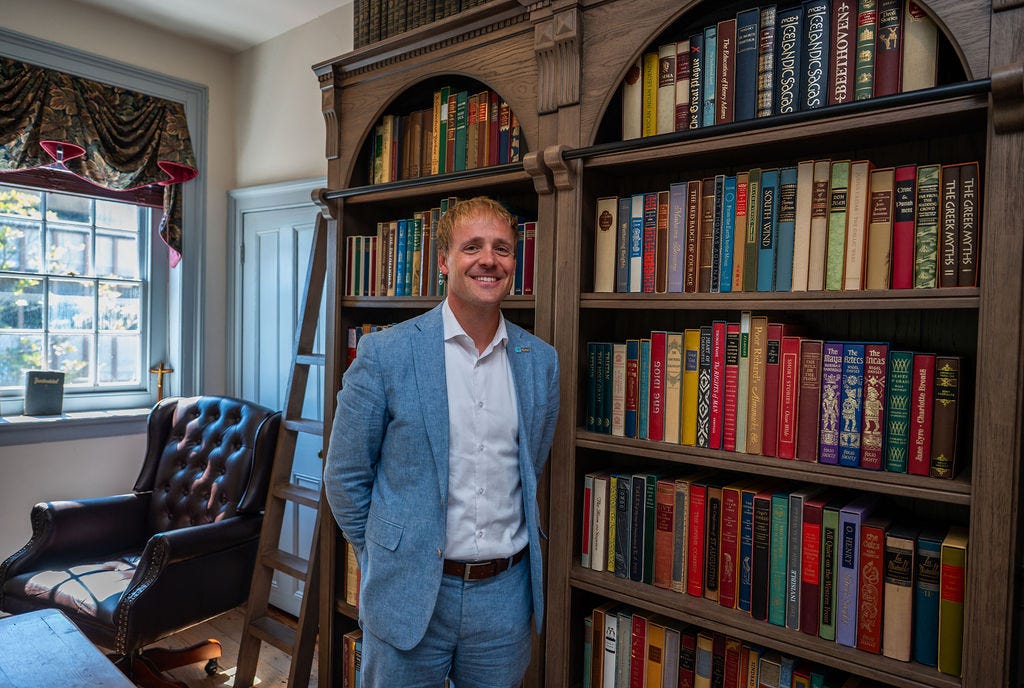
In Jeremy Tate’s office in Annapolis, Maryland, there’s a plaque bolted to the wall, with words engraved in tarnished brass. It’s the kind you’d find on a historical landmark, only this message is from the future; it reads: In 2040, the CLT surpassed the SAT and ACT as the number one college entrance exam globally.
“Every day we say our job is to come here and to make this become true,” Tate told me of the sign, which he had made two years ago.
On the surface, the Classic Learning Test (CLT) doesn’t seem all that revolutionary. It’s a two-hour test of reading, grammar, and math, taken by high school seniors as an alternative to the SAT or ACT. There are a few important differences though. Unlike the better-known tests, the texts are Western canon, not news article clips or the Common Core. There is no calculator. The reading passages are more than a few hundred words. The test does not get easier every year if students perform poorly.
The point of the CLT is to make college entrance academically rigorous again, so kids rise to the challenge—and so, ultimately, every high school classroom in America starts teaching the classics again. Tate says he’s “in a battle to save Western civilization.” And he’s not afraid of the competition.
In the last decade, our college entrance exams have been steadily dumbed down. The 2005 redesign of the SAT removed all logic questions and analogies, because these were “less connected to the current high school curriculum,” per the College Board. In 2016, in another redesign, the penalty for wrong answers was removed, and the essay portion became optional. (By 2021, the latter had been abolished, because of declining participation.) A no-calculator math section was added as a nod to rigor, but was eliminated entirely in 2024, when the test went fully digital.
There’s more: The SAT reading passages were once around 500 and 750 words, before the test went digital; today, the longest is 150 words and the shortest is 25, a single sentence. The College Board’s own explanation is that shorter content helps “students who might have struggled to connect with the subject matter.”
But even as the tests got easier, certain critics insisted that the SAT and ACT were still too difficult for students who weren’t privileged enough to have had tip-top exam prep; they were better measures of family wealth than academic ability, some claimed, whereas GPA was a fairer way to evaluate students. Then came 2020, when the one-two punch of lockdown learning and “the great awokening” turbocharged the test-optional movement. That year, more than 600 schools dropped their entrance exams. The Ivies all followed suit, most within two weeks of each other, in June 2020.
These days, GPA increasingly has its problems, too. When a student can produce a polished essay or complete a problem set with AI, their transcript stops being a reliable signal of anything. And so in recent months, the most competitive universities in America have done a volte-face. Since early 2024, Harvard, Yale, Brown, Dartmouth, Penn, and Cornell have all reinstated testing requirements, as will Princeton starting in 2027. Last week, over 800 University of California faculty members signed an open letter demanding the return of standardized testing requirements for STEM applicants—because since 2020, the number of incoming students with math skills below a middle-school level has increased nearly thirtyfold.
But Tate thinks reinstating the SAT is just a Band-Aid, given how easy the test has gotten. He said he was told by an administrator at one unnamed Ivy, which has reinstated its SAT requirement, that half their applicants now score above 1,500, meaning the test is no longer “really doing its job in terms of differentiating.” Ivy League deans and provosts, he says, no longer take the scores seriously. “They know the scores are so inflated,” Tate told me.
The whole premise of the CLT, says Tate, is that standards should pull students upward, not bend to meet them on the way down. “We shouldn’t change the test just because they can’t pay attention anymore because of Instagram,” he said.
In 2024 alone, more than 250,000 students took the test, marking the most popular year since its founding in 2015. But the College Board, which administers the SAT, has pushed back—questioning whether it can reliably predict college success because it does not yet have a long track record. And like everything else in America, the fight over the test has somehow become politically polarizing—because, while Tate doesn’t want federal pressure to be the mechanism for adoption, the Trump administration has become the CLT’s most powerful patron. Secretary of Defense Pete Hegseth recently directed all five military service academies to begin accepting CLT scores for the 2027 admissions cycle. (“The CLT is the gold standard,” Hegseth wrote, “and our academies need to attract the very best.”) A bill to codify Hegseth’s policy into federal law has been introduced by Republicans in both chambers.
The left, meanwhile, has turned its nose up at the test. In Indiana, where the state Senate voted 67-29 and the House 39-9 to accept the CLT at Purdue and Indiana University, only one Democrat voted for it. Other critics say the classical sources the test relies on are “racist, sexist, homophobic.”
“It’s bizarre,” said Tate. “I mean, it’s literally a test with Jane Austen and Frederick Douglass.” To him, it’s not about politics. “I’d love for it to be more of a free market response,” he said. “ ‘This is the most serious test, adopt it on those grounds. ’ ”
I interviewed Tate, 45, from the passenger seat of his car, as he drove to his daughter’s high school graduation ceremony. On the dashboard was a rosary, and on his Apple CarPlay was the Hallow prayer app. As we made our way through Manhattan, Tate on his way back to Maryland, he explained that he didn’t set out to build a test.
Tate spent a decade teaching in public schools. When he asked students what education was for, he said, they gave the same answer: to get a good job. He’d write a Plato quote on the board—the object of education is to learn to love what is beautiful—and watch his students slouch back in their chairs, staring back at him blankly.
By 2015, he was running an SAT prep company with contracts at Catholic schools in Baltimore, and he noticed that kids who went to classical or religious schools, where the curriculum is more traditional, were feeling abandoned. The SAT and ACT had both aligned with Common Core, and didn’t reflect the education the students were getting, or the college educations they were hoping to get, either.
His initial plan was modest: find whoever was building the inevitable alternative and be the first to offer a prep course for it. But nobody was building it, so he did it himself.
Since its first administration to 46 students in 2016, the CLT has grown from a niche option at small religious colleges like Hillsdale and Thomas Aquinas to a test accepted by hundreds of universities. By now, 500,000 students have taken the CLT. In 2023, Florida governor Ron DeSantis made the CLT an equal alternative to the SAT and ACT across the entire state university system. And these days, the company that administers the CLT, Classic Learning Initiatives, is making $12 million in annual revenue and employs about 75 people full-time.
Tate recruits almost exclusively from places like St. John’s College in Annapolis, Maryland, which has no majors and requires every student to read the same list of great books for four years. “They should be the most unemployable people ever,” Tate said. “All they’ve done is read old books their whole life. But they’re amazing employees, and it’s really hard to get at why. They’re uniquely human people.”
The hires are also Tate’s answer to the question he gets asked most: What’s the point of a classical education in a world where AI can summarize any book, answer any question, and write any essay? In a world where kids choose a school based on what internship they can get out of it? “I don’t think real liberal education is ever going to win on ROI,” he told me. “It’s already the wrong framing. I don’t know if you’re going to make more money, but you’re going to know what it means to be human. You’re going to value being alive more. You’re going to think about big things a lot more.”
The test itself has three sections of 40 questions each: verbal reasoning, grammar and writing, and quantitative reasoning.
The verbal section is where the CLT most visibly parts ways with its competitors. Where the SAT serves up paragraphs the length of a tweet, the CLT asks students to read and analyze passages from Aristotle on ethics, Augustine on the nature of truth, Flannery O’Connor on the vocation of fiction, and John Henry Newman on the idea of a university. The “author bank” stretches from the Epic of Gilgamesh in the 18th century BCE through Dante, William Shakespeare, Martin Luther King Jr,. and Toni Morrison.
The math section covers algebra, geometry, and logic, and requires students to work through problems by hand. “We forgot that math is supposed to be formative and shape people and order thinking in the right ways,” Tate told me. “And you had a whole generation become dependent on the device”—as in calculators—”because of what the SAT did.”
Tate is betting that if colleges start accepting the CLT en masse, the high school curriculum will change as a result. “If teachers know they’re going to see Aristotle, Dante, Jane Austen on the most important test, it will shape what’s happening in the classroom,” he said.
The test is also gaining ground beyond the classroom. Earlier this year, the State Department—led by Secretary Marco Rubio, who has fired nearly 250 foreign service officers and overhauled the diplomatic corps’ entrance exam to eliminate DEI considerations—contracted a staffing firm called RedBalloon to rebuild its pipeline of foreign service officer candidates, Tate told me. RedBalloon, in turn, reached out to CLT a couple of months ago to purchase data on its top 10 percent of scorers who had indicated they were open to recruitment opportunities. The pitch to those students: Skip college and come work for the U.S. government.
Andrew Crapuchettes, the CEO of RedBalloon, told me that a Foreign Service officer might get a call at the gym at 10 in the morning and be told she’s on a 3 p.m. flight and headed to a classified destination. She lands in Istanbul and has 24 hours to help coordinate a diplomatic negotiation. “To do that,” Crapuchettes told me, “you need to have a deep understanding of the culture that built Persia and Turkey. You need to understand the classics, world history. That’s why CLT is such a good way to identify people who are going to be a good fit.”
Crapuchettes also told me he had introduced CLT to State Department contacts with the longer-term goal of having Tate’s organization help redesign the Foreign Service officer exam itself, a test Crapuchettes compares in difficulty to the LSAT. If CLT gets its way, the test that determines who represents America to the rest of the world could one day look a lot like the one Tate built for high school students.
The appeal, Crapuchettes argues, is that people who are fluent with the texts that shaped Western civilization are more likely to understand—and believe in—the country they’d be representing abroad. “They’re just trying to bring people into the foreign service who actually are patriotic,” Crapuchettes told me. “The rest of the world has a skewed view of America because of the type of people we’ve put in the State Department, and we’re trying to fix that as quickly as possible.”
Most of the Ivy League, for now, remains a closed door. Tate told me he can’t get a meeting at Harvard, Yale, or Princeton. The message he gets back, he says, is that CLT is fringe and too conservative. Still, Tate believes that the more students want to take the CLT, the more colleges will have to accept it, for purely practical reasons. Nearly 300 colleges closed between 2008 and 2023, and in the first nine months of 2024 alone, 28 more shut their doors—nearly one a week. A Federal Reserve analysis projects as many as 80 additional closures between 2025 and 2029. The schools that survive, Tate reasons, will be competing ferociously for every applicant they can find.
“If not accepting CLT means they lose out on literally 10 applications,” he said, “they’re going to do it. We’ve already seen that—schools that don’t like us because they think Western civilization is bad or something, but they still have to adopt us because there are already so many kids taking it.”
The Free Press ForumParenting & EducationRaise kids without losing your mind or your principles. Discuss parenting, schools, higher education, and the future of learning.
Tate is not interested in creating the conservative SAT. He wants the CLT to be the best test, the one that most accurately identifies students ready for serious academic work. “I want to win,” he told me. “We have very much a Nike or Under Armour mentality. Business is a battle without bullets. And we think we can win on having a better vision for education, better content, and a better user experience.”
The evidence, so far, is promising but limited. (The Iowa Board of Regents rejected the CLT because there were no peer-reviewed studies that showed the test could predict college success.) The only published study to date was conducted at Grove City College, a small Christian institution in Pennsylvania that has accepted the CLT since 2017. Analyzing 235 students, Grove City’s assistant dean for institutional assessment found a significant positive correlation between CLT scores and first-year GPA, retention, and graduation rates. He also compared his data to a 2024 College Board study on SAT predictiveness and found CLT scores edged out SAT scores by five basis points, suggesting that the CLT may be “a more precise instrument for forecasting student success. “ Still, most of the students who take CLT are largely homeschooled or privately educated, which means they were already predisposed to do well at a place like Grove City.
But more data is coming. Three top-tier universities, including the University of Texas, are launching outcome studies this fall, tracking how well CLT scores predict freshman GPA compared to the SAT and ACT. The results are expected in 2027—and Tate’s not worried. He has no doubt that he’s on the way to fulfilling the goal he had engraved in that brass plaque.
“I’m so confident we’re going to be more predictive than the new SAT, which is a joke,” Tate told me. “I’m willing to bet the whole company on it.”